

Last Updated: November 24, 2026
Quick Summary
Choose a toddler coat for rainy school days by matching waterproofing, hood, and fit to your child's daily commute, then layering underneath for warmth. Prioritize a fully waterproof shell with sealed seams, an attached or adjustable hood, and enough room through the shoulders for a sweater.
- Buy a toddler raincoat one size up from true size, not two, for layering and growth.
- Waterproof fabric keeps water out entirely, while water-resistant fabric soaks through in steady rain.
- Dress your toddler in a thin base layer, a midlayer, then the waterproof shell.
- A mid-thigh hem prevents tripping, while below-the-knee coats catch a toddler's stride.
- Avoid long neck drawstrings and choose toggles or elastic adjusters for safety.
Table of Contents
- How do I choose a toddler coat for rainy school days?
- Toddler raincoat sizing: getting the fit right for layers and growth
- What to wear on a rainy day for kids: a simple layering plan
- Why a toddler rain jacket with hood beats a separate hat
- Waterproof versus water-resistant: what the labels actually mean
- Warmth, breathability, and comfort for all-day wear
- School-day practicality and toddler safety checks
- Shop the Le Petit Kids rainwear collection
- Frequently Asked Questions
How do I choose a toddler coat for rainy school days?
Choose a toddler coat for rainy school days by matching the coat's waterproofing, hood, and fit to your child's daily commute, then layering underneath for warmth.
A toddler coat for rainy school days should block rain first and insulate second, because wet fabric pulls heat away fast.
Here is the short version of what to look for before you buy.
| Feature | What to look for | Why it matters |
|---|---|---|
| Waterproofing | Fully waterproof shell with sealed seams | Blocks rain first; wet fabric pulls heat away fast |
| Hood | Attached or adjustable hood with toggle | Keeps rain off head and neck without slipping or getting lost |
| Fit | One size up from true size | Room for a sweater and a season of growth |
| Shoulders | Sits on shoulder bone, about a fist of extra room | Slides off if too big, bunches under backpack if narrow |
| Sleeves | Cuffs land at wrist bone with arms relaxed | Cuffs covering the whole hand drag in puddles |
| Hem | Mid-thigh | Below the knee catches the stride and is a trip hazard |
| Layering | Thin base layer, midlayer, then shell | Pieces can be removed when the classroom runs warm |
| Safety | No long neck drawstrings; reflective details | Drawstrings are a snag hazard; reflective strips help drivers see |
Toddler raincoat sizing: getting the fit right for layers and growth
Buy a toddler raincoat one size up from your child's true size, not two. One size gives room for a sweater underneath and a season of growth; two sizes leaves the hem near the ankles and the sleeves past the wrists, which trips small walkers and lets rain run up the fabric.
Toddler raincoat sizing comes down to three checkpoints:
- Shoulders: the coat should sit on the shoulder bone, not slide off it. Pinch the fabric at the chest; you want about a fist of extra room, no more.
- Sleeves: cuffs should land at the wrist bone with arms relaxed. If they cover the whole hand, they will drag in puddles.
- Hem: mid-thigh is ideal. Below the knee on a toddler means the coat catches their stride.
European sizing runs differently from US sizing, and it is not consistent across brands. A Catimini 3 In 1 Rain Coat Puffer Jacket Cm44075 shows how layering room works in practice: the rain shell and puffer are cut to be worn together or separately, so you can size for the shell and let the inner layer handle cold mornings.
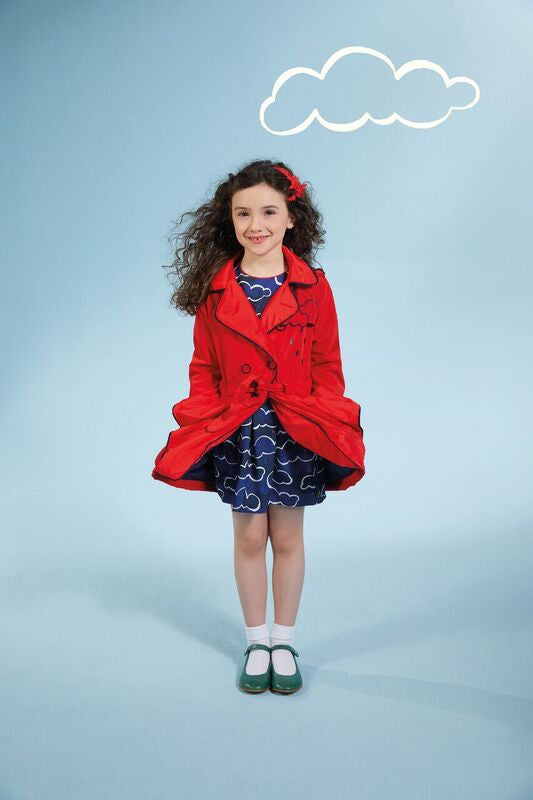
What to wear on a rainy day for kids: a simple layering plan
Dress a toddler for rain in thin layers rather than one thick coat, so pieces can be removed when the classroom runs warm.
Here is the plan we recommend for a wet school morning:
- Base layer: a soft cotton or wool-blend top and leggings. A Petit Bateau 2pc Set 7244409 works well as the foundation under a raincoat.
- Midlayer: a light fleece, sweater, or thin puffer for cold mornings. Skip it on mild days.
- Shell: the waterproof raincoat with hood.
- Extras: rain pants if the forecast is steady, and a spare pair of socks in the backpack.
The rule of thumb: if your child is warm in a T-shirt indoors, add the shell only. If the walk is below about 50°F, add the midlayer. Teachers will thank you for layers they can remove rather than a coat the child sweats in all morning.
Why a toddler rain jacket with hood beats a separate hat
An attached hood keeps rain off the head and neck without slipping, getting lost, or being pulled off mid-walk.
A toddler rain jacket with hood also seals better at the collar.
Look for an attached hood with a bit of structure or an adjustable toggle. A Molo Kids Waiton Rain Jacket Cloudy Day is the kind of hooded shell we point parents toward when they want one piece that handles the whole walk.
Waterproof versus water-resistant: what the labels actually mean
Waterproof means the fabric is engineered to keep water out entirely, usually through a coating, a membrane, or sealed seams. Water-resistant means the fabric slows water down but will soak through in steady rain or after prolonged wear.
Read the label for four things:
- Waterproof rating: a number in millimeters (mm) describing how much water pressure the fabric resists before water passes through. Higher ratings resist heavier rain. Seam construction and the DWR finish also affect real-world performance.
- Seam sealing: taped or sealed seams stop water sneaking through stitch holes. A waterproof fabric with unsealed seams still leaks. Check the hood and shoulder seams first, since those take the most direct rain.
- DWR coating: a durable water repellent finish that makes water bead and roll off the outer fabric. It wears away with abrasion, washing, and folding, and it can be renewed.
A Catimini Lined Raincoat CM42075 is a good example of a labeled raincoat with an attached hood and a warm fleece lining, the kind of piece that lets you apply the waterproof-label checklist to a real garment.
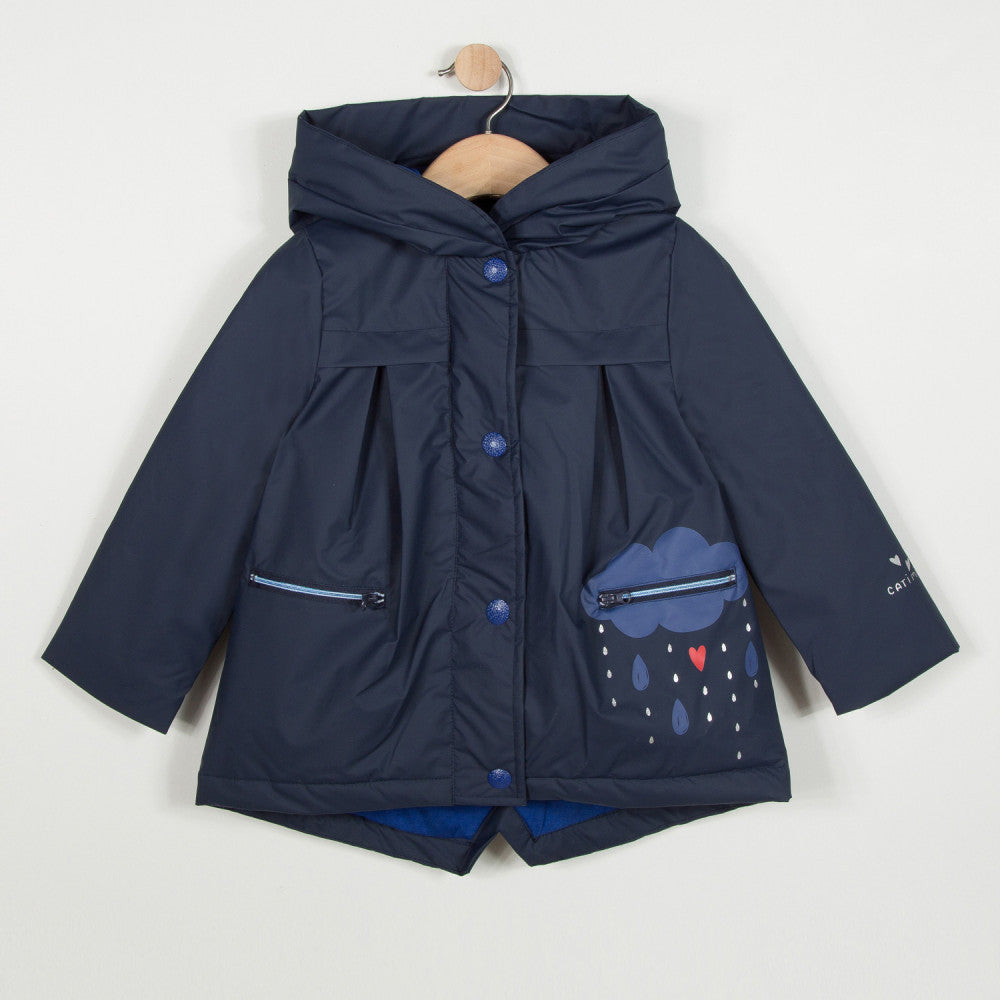
How to keep a school raincoat waterproof
Over a season, the DWR finish on a raincoat can wear off, so a coat that stops beading water may need attention.
A practical maintenance routine:
- Wash when the coat looks dull or water stops beading. Use a technical outerwear detergent rather than a standard detergent, which can leave residues that attract water. Follow the care label; most shells tolerate a gentle cycle.
- Skip fabric softener and bleach. Both damage the membrane and the DWR finish.
- Tumble dry low or warm if the care label allows. Gentle heat reactivates many DWR finishes, and beading often returns after a low-heat dry.
- Reapply a spray-on or wash-in DWR product when water no longer beads after washing and drying. This is routine, not a sign the coat is failing.
- Air-dry fully before storage and hang rather than crumple the coat, so the membrane is not creased in the same spot all season.
Warmth, breathability, and comfort for all-day wear
Warmth without breathability turns a raincoat into a sauna. A toddler who sweats inside a non-breathable shell gets cold the moment they stop moving, which is exactly what happens when they sit down in a classroom.
Balance the two like this:
- Breathable fabric lets moisture vapor escape so the child does not overheat on the walk.
- Insulation belongs in the midlayer, not the shell, so it can be removed indoors.
- Lining adds comfort against the skin; a fleece lining suits cold, wet mornings.
School-day practicality and toddler safety checks
School-day rain gear has to survive a toddler's whole day: the commute, the cloakroom, outdoor play, and the walk home.
Getting the coat on and off independently
A toddler who cannot manage their own coat spends the morning waiting for an adult, and a coat that is hard to remove stays on indoors until the child overheats.
- Front zipper plus snaps a toddler can manage alone. A zipper that starts at the very bottom hem is harder for small hands than one with a snap at the top of the placket.
- Large zipper pulls or toggles that are easy to grip with cold or wet fingers.
- A loop or hanging tab at the collar so the coat has a defined place on a cloakroom hook and does not end up in a pile on the floor.
Bathroom independence
A long raincoat that reaches the ankles is a bathroom problem: a toddler managing a toilet with a coat that drags on the floor ends up wet and frustrated. A mid-thigh hem, a two-way zipper if the coat has one, and a cut that lets the child pull the coat up and out of the way matter more than an extra inch of coverage.
Backpack compatibility
Most toddlers carry a small backpack to school, and a coat that is cut narrow through the shoulders will bunch under the straps and ride up the back, leaving the lower back exposed to rain.
- Check that the coat fits over the backpack straps without pulling at the armpits.
- A slightly roomier cut through the chest and shoulders is more useful than a longer hem.
- If the backpack is worn under the coat, size the coat for that layer; if it is worn over the coat, the straps need to sit flat on the shell rather than sliding on slick fabric.
Hood visibility and safety
An attached hood keeps rain off the head and neck, but a hood that is too deep or too stiff blocks peripheral vision, which is a real hazard on a wet walk and in a busy playground.
- The hood should sit back far enough that the child can see to the sides when it is up.
- Avoid long drawstrings at the neck; they are a snag and strangulation hazard on playground equipment (Drawstrings in Children's Upper Outerwear). Toggles and elastic adjusters are safer.
- Check that the hood does not flop forward over the eyes when the child looks down.
Snag and trip hazards
- Hem length: below the knee on a toddler catches the stride and is a trip hazard on wet pavement. Mid-thigh is the practical target.
- Loose cords and toggles: anything that dangles at the waist or cuffs can catch on playground equipment. Prefer elastic cuffs and internal adjusters over long external cords.
- Reflective details: small reflective strips help drivers see a child on dark, wet mornings, and they cost nothing in comfort.
Classroom transitions and all-day comfort
A raincoat that is warm on the walk becomes a problem in a heated classroom.
Label the inside with your child's name. Raincoats are the most commonly swapped item in a crowded cloakroom, and a named coat is the one that comes home.
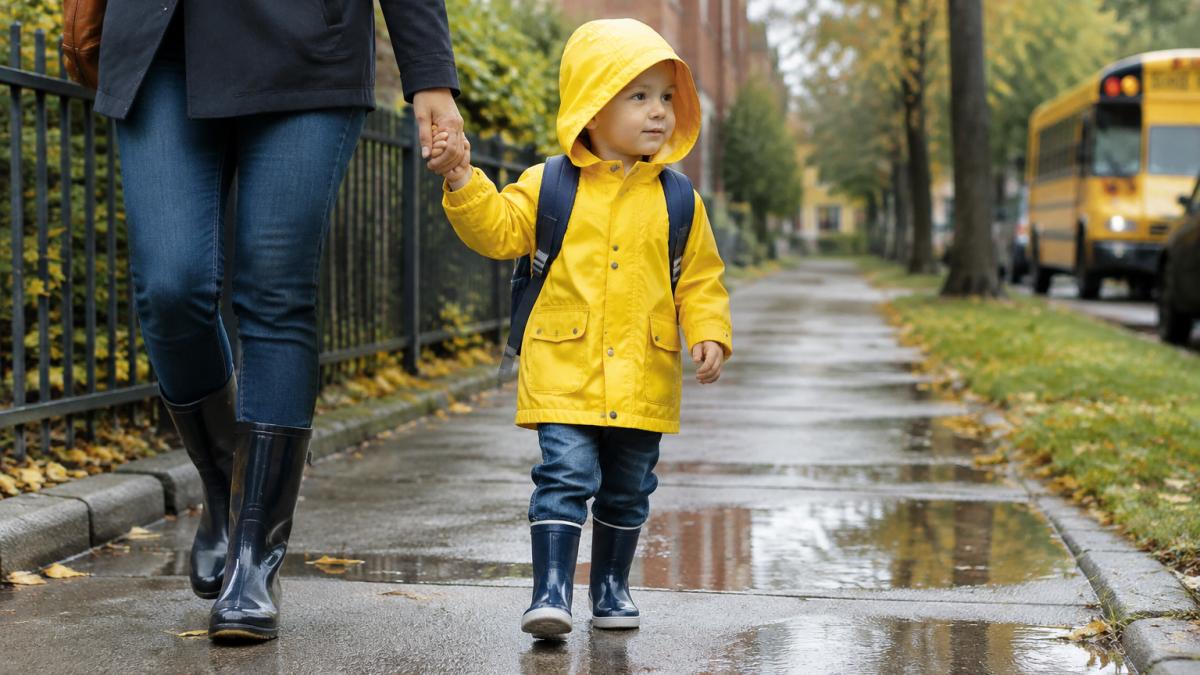
Shop the Le Petit Kids rainwear collection
Our rainwear edit is built around the pieces that solve the problems above: waterproof shells with real hoods, linings for cold mornings, and outerwear cut for layering. A 3 Pommes Jacket Hat pairs a hooded waterproof trench with a matching hat, a ready-made answer for the walk to school.
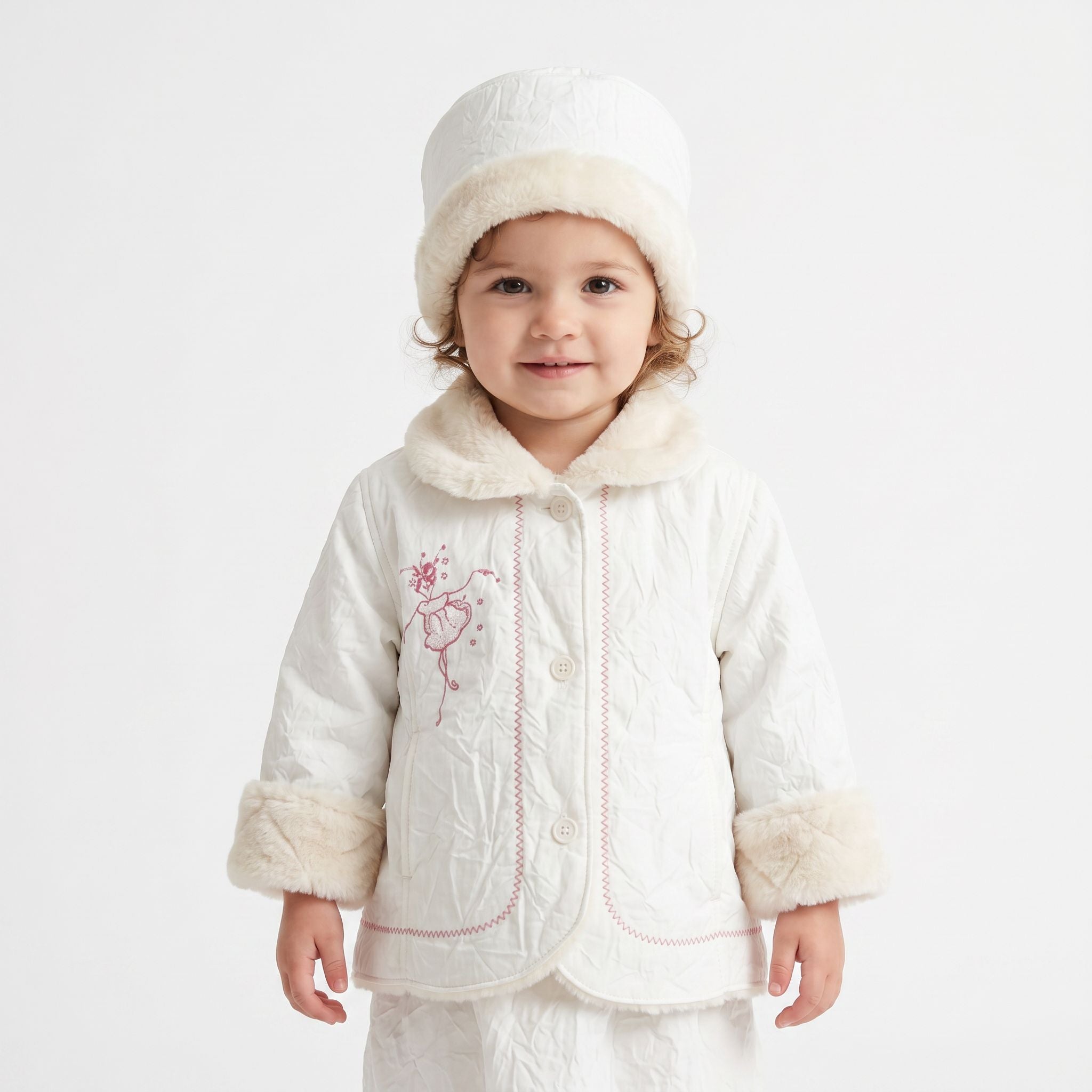
When you shop with us, you are choosing curated European designer outerwear in a size range from newborns through teens.
Rainy school days do not have to mean a soaked commute or a shivering child. Start with a properly fitted waterproof shell, layer thin underneath, and check the hood and closures before you buy.
Frequently Asked Questions
Does a toddler need a waterproof or water-resistant coat for school?
For rainy school days, a waterproof coat is the safer choice. Waterproof shells keep a toddler dry through puddles, drizzle, and a wet walk to the car, while water-resistant fabrics only handle light rain before moisture soaks through. Look for taped or sealed seams and a DWR coating on the outer fabric.
How should a toddler rain jacket with hood fit over layers?
A toddler rain jacket with hood should leave room for a sweater or fleece without swallowing your child. Check that the shoulder seams sit near the natural shoulder, the sleeves cover the wrist when arms are raised, and the hem clears the knees for easy walking. Snap-adjustable cuffs and a removable hood help fine-tune the fit as your child grows. Always try the coat on over the layers your toddler will actually wear on a rainy school day.
What should a toddler wear under a raincoat on a chilly school day?
Start with a moisture-wicking base layer, add a light fleece or sweater as a midlayer, and finish with the rain shell. This combination lets you adjust for temperature swings between the morning commute and the classroom. Avoid bulky puffer jackets under a raincoat because they restrict movement and trap sweat. If the day is cold and wet, a 3-in-1 set with a zip-out puffer gives you both options without buying two separate coats.
How do I keep a toddler's raincoat easy to put on at school?
Choose a coat with a smooth zipper, a snap or flap closure over it, and a roomy hood your child can pull up without help. Practice putting it on at home a few times before the first rainy morning. Label the inside collar and check that the cuffs are not too tight over sleeves. The MOLO Helen Raincoat has a zipped front with snaps, a removable hood and snap adjustable cuffs.
